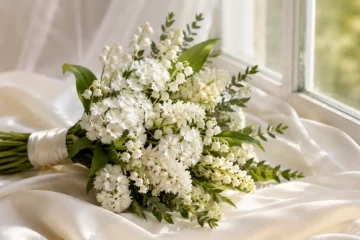
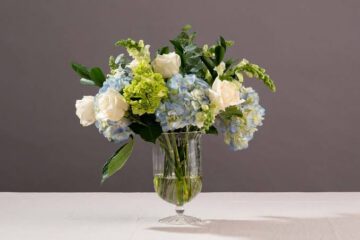
The bridal bouquet is the most photographed floral object at any wedding and the one most likely to be quietly struggling by the time the reception photos are taken. It is held out of water for hours, in whatever the weather is doing, gripped by a nervous hand, and expected to look immaculate throughout.
Which means choosing wedding bouquet flowers is not primarily an aesthetic exercise. It is an engineering one, and the aesthetics follow from it.
Shapes, and What Each One Suits
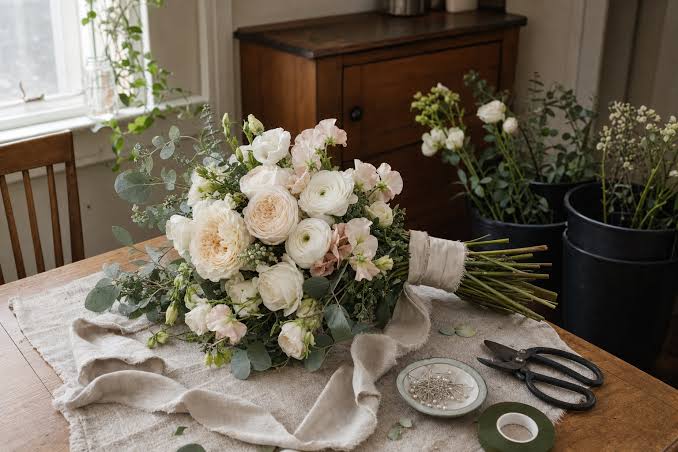
Hand-tied round (or posy). Built with a spiral stem technique so it stands on its own. The most common shape, works with almost any dress, comfortable to hold. Ranges from compact to loose and garden-style depending on how tightly it is built.
Loose garden style. A hand-tie with deliberate asymmetry, movement and gaps. Beautiful, contemporary, and the most vulnerable to wind – avoid for exposed harbour and clifftop ceremonies.
Cascade or trailing. Flowers descending below the hand. Traditionally wired or built on a holder. Dramatic, expensive because of the labour, and heavy. Suits fitted and column gowns, and tall frames.
Sheaf or presentation. Long-stemmed, flat-backed, carried in the crook of the arm. Elegant, understated, and one of the cheaper shapes because it uses stem length rather than stem count. Underused.
Single stem. One magnolia branch, one king protea, one enormous peony. Confident, cheap, and photographs extremely well. Suits minimal dresses and modern venues.
Pomander. A sphere on a ribbon, usually for flower girls. Cute, and children genuinely find them easier to hold.
Getting the Size Right
The most common bouquet mistake is scale, in both directions.
Against your frame. A bouquet should sit at natural waist-to-hip level and read as roughly a third to a quarter of your torso width. Too large swamps a petite frame; too small looks lost against a full gown.
Against the dress. A heavily beaded, textured or lace gown competes with a busy bouquet – go simpler and more monochrome. A plain silk or crepe gown can carry a much more complex bouquet.
Against the bridesmaids. Bridesmaid bouquets should be visibly smaller, usually around 60-70% of the bridal bouquet, in the same palette. If they are the same size, the photographs read oddly.
Weight matters. A large cascade with woody stems and a holder can be genuinely heavy, and you are holding it for hours while shaking hands and hugging relatives. Ask to hold a mock-up at the consultation if you can.
What Survives Out of Water
This is the decision that determines whether the bouquet in the reception photos looks like the bouquet in the ceremony photos.
Excellent out of water:
- Natives – banksia, protea, waratah, kangaroo paw, waxflower, gum foliage. Built for this climate, essentially indestructible over a day.
- Lisianthus – looks delicate, is genuinely tough.
- Chrysanthemum in modern antique tones – unfashionable, extraordinarily durable.
- Orchid – expensive per stem, holds for a very long time.
- Carnation and alstroemeria – both underrated, both robust.
- Roses – good, provided they were properly conditioned and seared beforehand.
Struggles out of water:
- Hydrangea – the worst offender. It can visibly collapse within an hour in heat. Beautiful, and a real risk in a hand-held bouquet.
- Gardenia – stunning, bruises if you look at it, browns quickly.
- Sweet pea and anemone – delicate and short-lived.
- Peony – a genuine spring treasure, but fully open peonies blow out fast in heat. Ask for them slightly closed.
- Magnolia flower – lasts hours, not a day.
None of these are forbidden. But if your wedding is outdoors in a Sydney summer, building a bouquet around hydrangea and gardenia is a decision you should make knowingly.
Seasonal Choices in Sydney
Spring (Sep-Nov) – the best and busiest season. Ranunculus, tulip, sweet pea, stock, freesia, garden rose, blossom branch. Peony has a genuine window in October and November. If you want peonies, this is when they are Australian-grown, in season, and merely expensive rather than absurd.
Summer (Dec-Feb) – hydrangea, dahlia, lisianthus, agapanthus, orchid, gardenia. Design for heat first. Ask for the bouquet delivered in water and only removed at the last moment.
Autumn (Mar-May) – chrysanthemum in bronze and antique tones, dahlia, protea, banksia, celosia, berried and rust-toned foliage. The best-value season, and arguably the most beautiful for bouquets – warm, rich, textural and durable.
Winter (Jun-Aug) – anemone, hellebore, magnolia branch, camellia, wattle, waratah. A single flowering branch as a bouquet is striking and costs very little.
Palette Notes That Matter for Photographs
- Warm palettes carry. Coral, peach, cream, rust, gold and blush read from a distance and hold up under any lighting.
- Deep blues and purples disappear against green foliage and go black under low light. Sydney’s bushland and garden venues are almost entirely green backdrops.
- All-white needs volume to read as luxurious rather than sparse. It is one of the most expensive briefs in floristry.
- White against a white dress needs contrast from foliage or texture, or the bouquet vanishes into the gown in photographs.
- Two colours plus foliage almost always beats five colours.
Australian-Grown, and Why It Holds Longer
A bouquet’s survival is decided before it is built, in the conditioning. That is a matter of both handling and provenance.
NSW has a substantial commercial cut flower industry – traditional flowers around the Sydney basin and Central Coast, and a significant native and wildflower sector along the coastal strip – documented in the state’s horticulture and primary industries resources. Local stems arrive at market hours after cutting rather than days after air freight, which leaves more of their life intact for your wedding day.
This is measurable rather than sentimental. Australian research on ethylene sensitivity and postharvest treatment of native cut flower genera shows how much difference handling and exposure make to how long stems hold. A florist who conditions properly and buys locally is buying you the difference between a bouquet that photographs well at 6pm and one that does not.

Realistic Costs in Sydney
Rough 2026 guidance, direct from a workroom:
- Bridesmaid bouquet: $90-180 each
- Modest bridal bouquet: $200-300
- Standard bridal bouquet: $300-450
- Generous or specialty bridal bouquet: $450-700
- Large cascade: $600-1,200, driven by labour more than stems
- Single-stem or sheaf: $80-200, the best-value credible option
- Buttonhole: $20-40 each
This is the one item worth protecting if the budget tightens. Cut aisle flowers, bathroom flowers and cake flowers before you cut the bouquet.
Keeping It Alive Until the Photos
- Keep it in water until the last possible moment. Ask your florist for a vessel, and use it during hair and makeup.
- Out of direct sun. A bouquet on a sunny windowsill during preparation has already begun to go.
- Cool room, not the car. A car in a Sydney summer reaches 60 degrees. Never leave it there.
- Do not refrigerate with fruit. Ethylene from ripening fruit will age it overnight.
- Mist lightly on the morning if the day is hot. Lightly.
- Between ceremony and reception, put it back in water. Nominate someone to do this.
- Afterwards, recut the stems, put it in a clean vase with flower food, and it will often last another week.
Questions for the Consultation
- Which of my chosen stems struggle out of water?
- What is the realistic weight of this shape?
- Can I hold a mock-up?
- Will this palette read against my venue’s backdrop and lighting?
- What is superb and in season in my month?
- Can it be delivered in water?
- What is your substitution policy in writing?
The Bottom Line
Good wedding bouquet flowers are chosen for what survives a long day out of water first and appearance second – and the good news is those two things overlap far more than people expect. Autumn natives, lisianthus, roses and antique chrysanthemum in a warm palette will look as good at 7pm as at 2pm. Get the scale right against your frame and dress, keep it in water until the last moment, and protect this line item above every other floral decision you make.