Ceremony flowers are looked at. Reception flowers are lived with for five hours by people who are eating, talking and taking photographs across tables. That changes almost every design decision, and it is the reason so many beautiful centrepieces are quietly resented by the guests sitting behind them.
This guide covers what actually works for wedding reception flowers in Sydney venues: heights, scale, where to concentrate spend, what venues allow, and how to get the ceremony flowers to work twice.
The Height Rule Nobody Enforces
A centrepiece must be either below sightline or well above it. Never in between.
Below sightline means under about 30cm from the table surface. Guests see across it and talk to each other. This is the correct default.
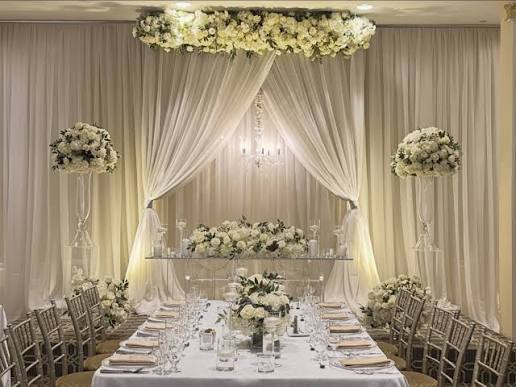
Well above sightline means a tall footed vessel or elevated stand where the flowers sit above 65cm, so people look under it. Dramatic, expensive, and genuinely effective in high-ceilinged rooms.
In between – a 45cm arrangement – blocks every conversation on the table and appears in photographs as a wall between the people you invited. It is the single most common reception flower mistake.
If you mix heights, alternate them across tables rather than putting both on one. And if the budget only supports one type, choose low. Low arrangements are cheaper, easier to transport, easier to reuse, and nobody has ever complained about them.
Long Tables vs Rounds
These need completely different thinking.
Round tables want a single centred arrangement, or a cluster of three to five bud vases with candles. Simple, and the eye reads it as complete.
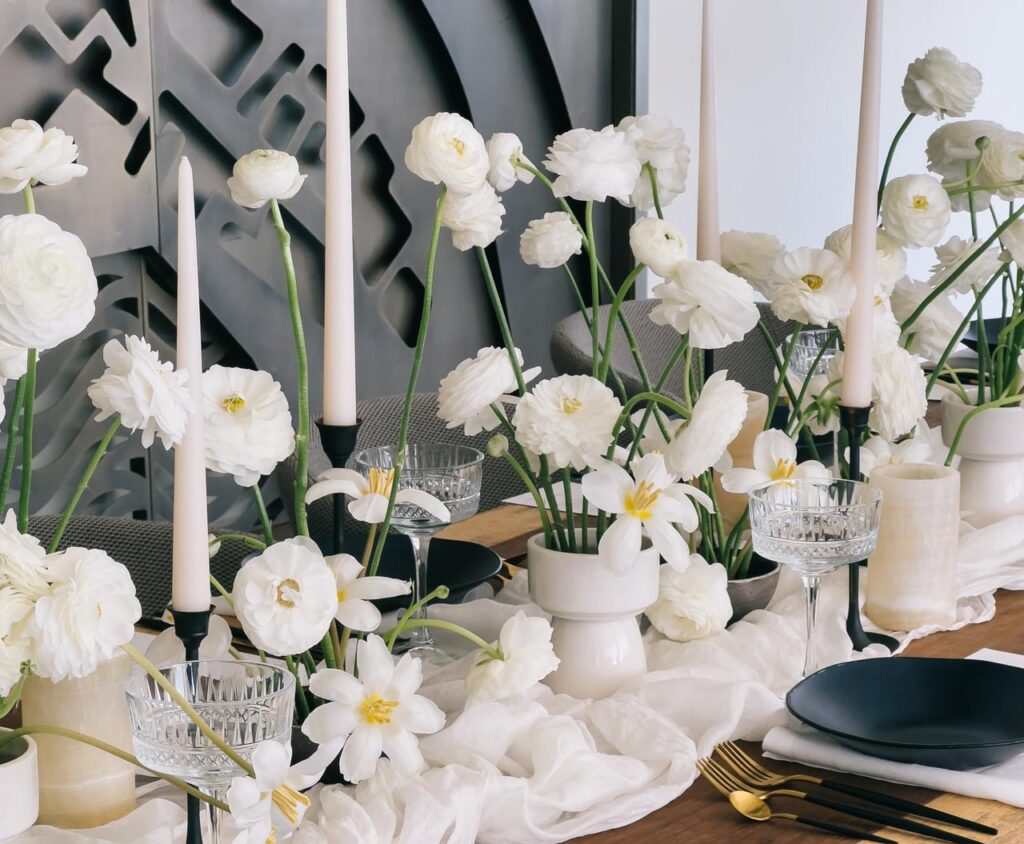
Long tables want a runner rather than a centrepiece – a foliage base with flowers distributed through it, punctuated by candles. Long tables with individual centrepieces every two metres look accidental. A continuous low run looks designed and, crucially, uses relatively few blooms for a lot of visual coverage.
Mixed layouts (a long top table plus rounds) should keep the same palette and materials but not attempt to replicate the same shape. The top table can be a runner while the rounds are centred posies.
Where to Concentrate the Reception Budget
Even distribution across a reception produces a room where everything is slightly underdone. Concentration is better.
Spend most on: one entry or focal moment guests walk into, and the top table. These are the two things every photograph includes.
Spend moderately on: centrepieces, but consider dressing alternating tables generously rather than every table thinly. Guests do not compare tables.
Spend least on: bar flowers, gift table, bathroom, signage, cake. All are nice. None are noticed if absent.
Candles carry a room for a fraction of what flowers cost, provided your venue permits open flame. Many do not, so ask before planning around them.
Reuse the Ceremony Flowers
Worth 20-30% of a floral budget and almost always available if planned.
- Ceremony arbour becomes the reception backdrop, or splits into two entry arrangements. Design it in movable sections from the outset.
- Aisle arrangements become table centrepieces – but only if they were built in vessels rather than spiked into the ground.
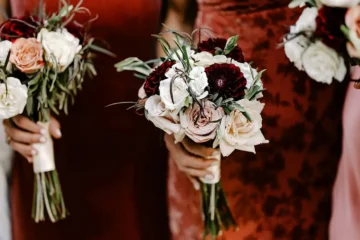
- Bridesmaid bouquets become the top-table run, lined up in small vases. Ask for the vessels to be at the venue.
- Ceremony pedestals move to the bar or entry.
Two conditions make this work: agree it at the consultation so the mechanics suit relocation, and nominate a specific named person to move things during the transition. “Someone will grab them” reliably means nobody does.
Venue Rules That Change the Design
Check these before you commit to a concept.
Open flame. A large number of Sydney venues prohibit naked flame, or require candles to be fully enclosed in glass. This significantly affects a candle-led design.
Bump-in windows. Many reception venues have a same-day event before yours and give you 90 minutes to two hours. That rules out anything requiring substantial on-site construction. Ask the exact window and tell your florist.
Fixings. Nails, screws, adhesives, cable ties on light fittings, anything touching heritage surfaces – usually prohibited. Suspended installations need venue engineering approval.
Pack-down. Most venues require everything removed the same night. Someone has to do that, and it is worth confirming whether your florist’s quote includes it.
Council venues and reserves have their own published conditions. If your reception is in a community hall, a park pavilion or a council facility, the relevant community venue and facility hire information sets out access times, structural limits and what may be installed on site.
While you are working through logistics, it is worth confirming the legal requirements are handled too. The NSW Government’s guidance on getting married in NSW covers celebrant registration and the mandatory onemonth Notice of Intended Marriage period, which is easy to lose track of during venue planning.
Seasonal Choices for Sydney Receptions
Reception flowers sit indoors under artificial light for hours, which changes what reads well.
Warm palettes carry. Coral, peach, rust, cream, gold and blush hold their colour under warm venue lighting. Deep blues and purples go black under low light and in photographs. Burgundy works in candlelight and disappears under downlights.
Spring (Sep-Nov): ranunculus, tulip, sweet pea, stock, freesia, garden rose, blossom branch. Peony in October and November only.
Summer (Dec-Feb): hydrangea, dahlia, lisianthus, agapanthus, orchid. Air-conditioned receptions are kinder to flowers than outdoor ceremonies, but transport in heat is the risk. Ask for delivery close to the event.
Autumn (Mar-May): chrysanthemum in bronze and antique tones, dahlia, protea, banksia, celosia, berried and rust foliage. The best value of the year and superb under warm lighting.
Winter (Jun-Aug): anemone, hellebore, magnolia branch, camellia, wattle, waratah. Flowering branches are outstanding in high-ceilinged heritage rooms and deliver scale cheaply.
Natives at a Reception
Underused, and practical. Banksia, protea, waratah, kangaroo paw, waxflower and gum foliage are locally grown, handle a long warm evening without complaint, and photograph as distinctly Australian rather than as a European wedding relocated.
NSW has a significant native and wildflower growing sector along the coastal strip and inland, documented in the state’s horticulture and primary industries resources. Because these stems are not air-freighted, they arrive with more of their vase life intact – and Australian postharvest research on vase life determinants in native cut foliage shows how much handling and harvest timing affect longevity. In practical terms, native arrangements are the ones still looking good when the venue staff pack them down at midnight.
Realistic Sydney Reception Costs
Rough 2026 guidance, buying direct from a workroom:
- Low centrepieces: roughly $90-180 per table depending on scale and vessel.
- Tall elevated centrepieces: roughly $220-450 per table.
- Long-table runners: priced per linear metre, commonly $120-250 per metre.
- Bud vase clusters: the cheapest credible option, often $50-90 per table.
- Top-table run: $400-1,200 depending on length and density.
- Entry or focal installation: from around $600 for something modest to several thousand for a statement piece.
- Delivery, install and pack-down: usually 10-20% on top. Confirm whether pack-down is included.
Seven Questions for Your Florist
- What is the exact bump-in window at this venue?
- Does the venue permit open flame, and does it need enclosed candles?
- What can be reused from the ceremony, and who moves it?
- Will this palette hold up under this venue’s lighting?
- Are the centrepieces below sightline or clearly above it?
- Is pack-down included in the quote?
- What would you cut first if we needed to save 25%?
The Bottom Line
Good wedding reception flowers keep centrepieces either genuinely low or clearly elevated, use runners on long tables rather than repeated centrepieces, concentrate spend on the top table and one entry moment, and reuse the ceremony flowers with a named person responsible for moving them. Check open-flame rules and the bump-in window before you fall in love with a concept, and pick a warm palette that survives the venue’s lighting. The room will look considered and the guests will still be able to see each other.